History of Drag-and-Drop Interfaces
The development of drag-and-drop interfaces is deeply rooted in the evolution of graphical user interfaces, which transformed computing from text-based commands to visual interaction. This transformation began in the 1970s at Xerox PARC (California, USA), where researchers aimed to make computers more intuitive for everyday users. Instead of typing commands, users could interact with icons, windows, and on-screen objects. These ideas were revolutionary at the time and laid the foundation for modern interface design. Throughout the 1980s and 1990s, major technology companies refined and commercialized these concepts, bringing them into homes and offices worldwide. Drag-and-drop became a natural extension of direct manipulation, allowing users to physically “move” digital items. As computing expanded into the internet era in the 2000s, this interaction model adapted to new environments. It later evolved further with the rise of mobile devices and touchscreens in the 2010s. Today, drag-and-drop is a universal interaction method across all major platforms and is widely used in web development and modern programming environments.
Early GUI Systems and Origins
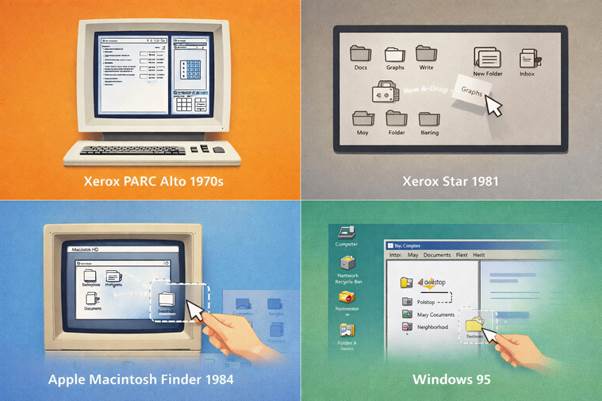
The earliest foundations of drag-and-drop emerged during experimental research into graphical interfaces in the 1970s at Xerox PARC (California, USA). One of the most influential systems developed during this time was the Xerox Alto in 1973, which introduced a mouse-driven interface with windows and icons. Visionaries like Alan Kay and Douglas Engelbart contributed to the idea that computers should be interactive and visually intuitive. These systems allowed users to select and manipulate objects directly on the screen, a concept known as direct manipulation. Although the Alto itself was not widely sold, it became a blueprint for future systems. In 1981, the Xerox Star further developed these ideas by introducing a desktop metaphor, where files and folders could be visually organized. This environment included early forms of object movement that resembled drag-and-drop interactions. The idea of moving items visually across the screen was inspired by physical office tasks, such as rearranging papers on a desk. These early implementations demonstrated that users could interact with digital content more naturally. The innovations from this period became the foundation for all modern drag-and-drop systems.
Adoption in Operating Systems
The transition of drag-and-drop from research labs to mainstream computing occurred in the 1980s, when commercial operating systems began adopting graphical interfaces. Apple Macintosh System Software, launched in 1984, was one of the first systems to fully integrate drag-and-drop into everyday use. Under the leadership of Steve Jobs, Apple focused on making computers accessible to non-experts, and drag-and-drop played a central role in that goal. Users could move files, organize folders, and delete items simply by dragging icons across the screen. This eliminated the need for complex commands and made computing more approachable. Later, Microsoft Windows expanded these capabilities, especially with the release of Windows 95, which introduced a more refined graphical interface. Microsoft’s approach brought drag-and-drop to a global audience, standardizing it as a core interaction method. Over time, additional features were added, such as dragging files between applications and external devices. These advancements made drag-and-drop an essential part of daily computer use. The adoption by major operating systems ensured its long-term success and widespread use.
Expansion into Web and Mobile Applications
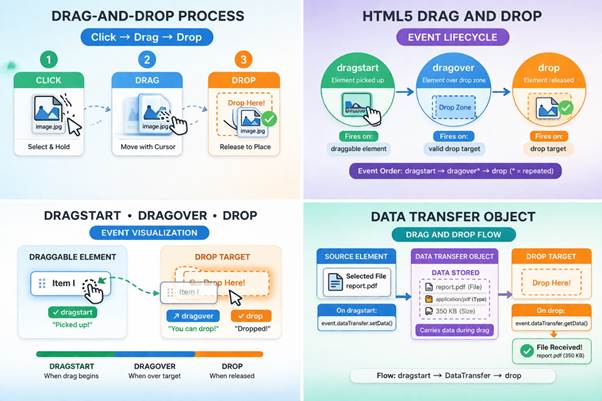
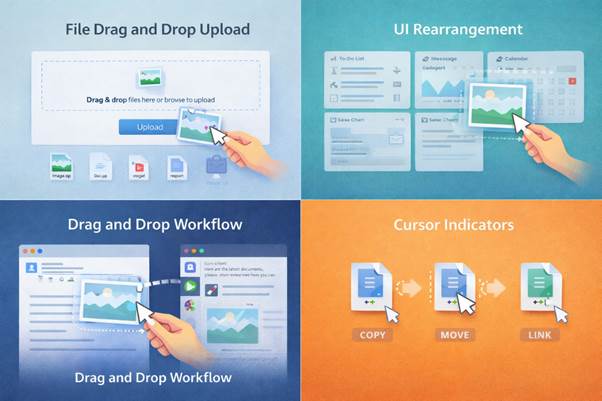
The expansion of drag-and-drop into web and mobile platforms marked a new phase in its evolution. A major milestone occurred in 2009 with HTML5, which introduced standardized drag-and-drop functionality. Companies like Google integrated these features into web applications. This allowed users to upload files and organize content efficiently. In many systems, files such as PDF documents may include security layers like a password. On the security side, systems must also protect against threats like virus, trojan, using antivirus solutions. Modern implementations often rely on compression techniques for faster data handling and require proper system administration for stability.